
The business world currently considers artificial intelligence as a leading technology which receives the most attention from companies. Organizations throughout various industries test AI tools which claim to deliver quicker results and better work efficiency and enhanced decision-making capabilities.
At first glance, it appears that companies are adopting AI at an unprecedented pace.
Employees use AI assistants to create email messages and produce reports and extract key information from documents and perform data analysis. Many business software platforms now advertise built-in AI capabilities within CRMs, analytics tools, and collaboration platforms.
The evidence shows that organizations operate through artificial intelligence technology.
The actual situation shows different facts from the first impression.
Companies need to adopt AI systems correctly because they miss out on major benefits from these technologies.
Organizations face two main challenges in their operations. Organizations lack the ability to track their AI projects which they use across all business functions.
According to industry studies, nearly 88% of organizations now use AI in at least one business function, yet only a small percentage are able to translate that usage into measurable business impact.
The biggest opportunity exists between organizations that test AI technologies and those who successfully implement AI into their operations.
Kandor AI provides a solution for solving this specific problem.
The Illusion of AI Adoption
If you were to go into any small-to-medium company today, you’d find most companies have some of their workers utilizing AI in various capacities.
For instance, marketing may leverage AI to help them with email campaign creation, or sales using AI for email responses to prospects, finance may play with AI data analysis tools to help summarize financial reports.
Individually, it’s very useful; however, as a whole they do not impact how a company operates.
Most companies are using AI as distinct functional productivity tools, rather than integrated into the overall company process.
As a result, each employee with different types of tools will use them independently from the company core processes, data environment, and decision-making processes.
Therefore, this lose association leads companies to believe they are “doing AI” when they are actually just scratching the surface of AI’s potential.
What Companies Are Actually Doing with AI
The study of organizational AI maturity development shows how businesses adopt AI technology while its advantages remain unknown to them.
Most companies fall into one of four categories:
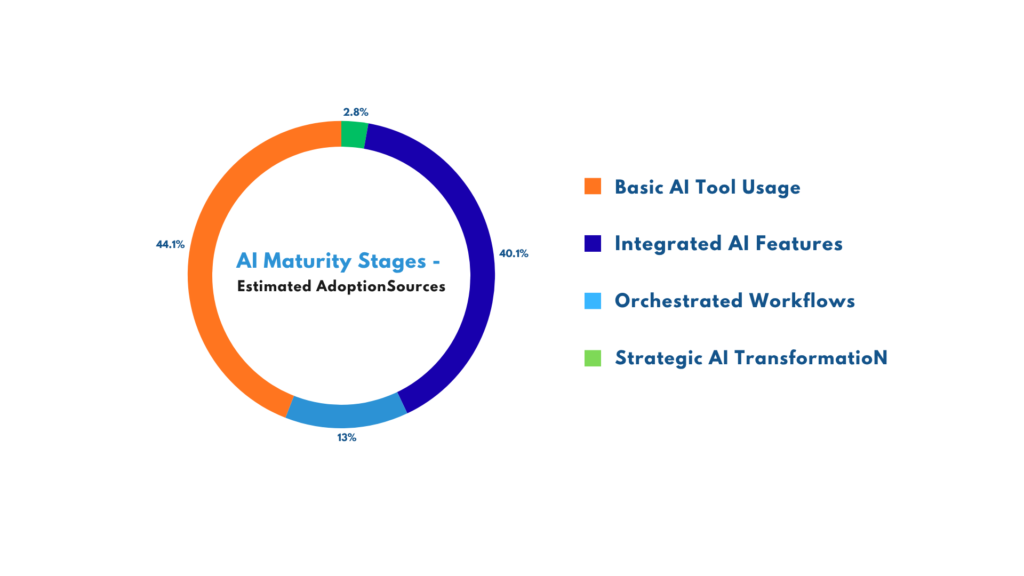
The majority of companies remain stuck in the first two stages. They use AI tools or enable AI features in existing platforms, but they rarely integrate AI deeply into the workflows that drive business performance.
Experimentation fails to create value because organizations lack the necessary capabilities to execute transformation successfully.
The Missing Middle in AI Implementation
Organizations still struggle to achieve business success through AI because they cannot overcome challenges in implementing AI technology. The main problem exists because essential components to link AI instruments with tangible results remain unfulfilled.
Organizations use multiple AI technologies including chatbots and analytics platforms and automated reporting systems and AI assistants but these solutions work as separate entities. The organization needs a comprehensive system that links all its data and operational processes and intelligence systems.
The gap between two points is commonly identified as the Missing Middle. The Missing Middle represents the layer that connects:
• AI tools that perform specific tasks
• business processes that drive operations
• operational workflows across departments
• decision intelligence used by leadership teams
The business incorporates AI into its daily operations through the connection of these components. The systems exchange data without interruption which results in faster processes and provides decision-makers with insights at the optimal time.
The absence of this essential connection causes organizations to experience disconnected AI projects.
Employees can use AI tools to enhance their work efficiency through email writing and document summarization and report analysis but the organization fails to achieve its full potential benefits through AI implementation.
The absence of this vital link results in mid-market businesses experiencing operational inefficiencies and operational delays while losing chances for advancement and development. The technology environment contains multiple AI tools which organizations treat as separate entities that do not produce substantial organizational change.
Organizations need to close this gap so they can start using their strategic value after they finish their testing phase.
The Difference Between AI Tools and AI Systems
AI tools and AI systems require different definitions. The orchestration process demonstrates its significance through its application to customer inquiries within standard business operations. The process in most organizations operates through these steps. A customer sends an inquiry through email or a web form. The request enters the company’s system. An employee manually reviews the message. Information is gathered across multiple tools.
The request is forwarded internally. A response is drafted and sent. Digital organizations require multiple hours or days to complete work because they need to solve complex tasks.
Now imagine the same workflow powered by AI orchestration.
The inquiry arrives and AI immediately:
• categorizes the request
• extracts key information
• checks customer history in the CRM
• Determines priority level
• Routs the request to the appropriate team
• Drafts a contextual response
• schedule follow-up tasks automatically
All of this can happen in seconds. The difference between the two situations exists because of the missing AI tools. The difference is how those tools are connected into a unified workflow.
The Value Gap: Tool Users vs Strategic Implementers
Companies that use AI tools without proper integration of their systems achieve only limited productivity gains.
Organizations that controlAI throughout their entire operations get much higher business benefits.
Research shows that value creation increases dramatically as companies move through different stages of AI maturity.
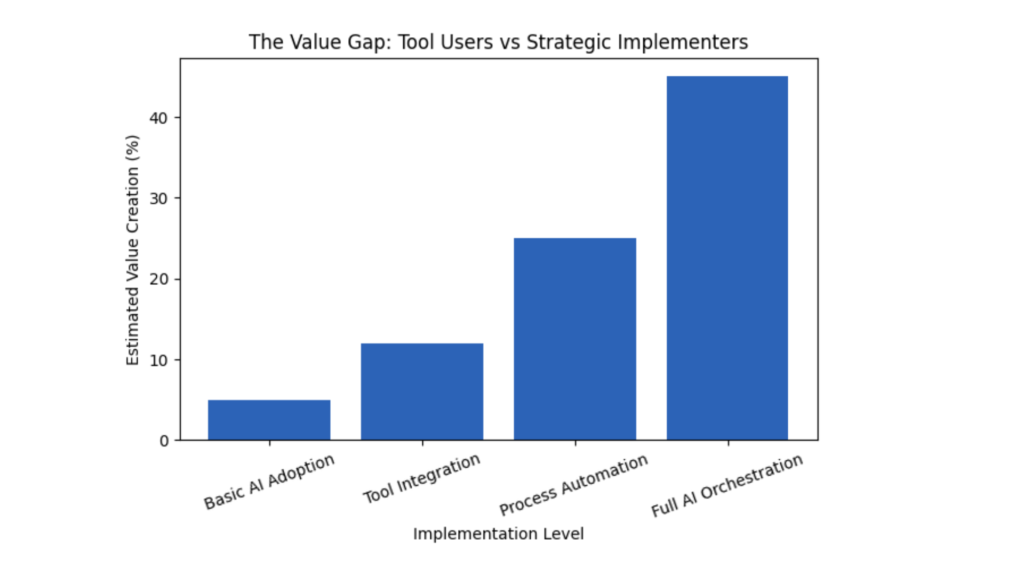
The data makes one thing clear.
The real value of AI does not come from using tools. It comes from embedding AI into business processes.
Why Most Companies Struggle to Implement AI
The Challenges Organizations Face when Trying to Adopt Artificial Intelligence. Organizations should be able to take advantage of the existing opportunity, yet numerous organizations fail to exploit it.
Organizations face multiple structural obstacles which prevent their progress.
Technical Complexity
The complex nature of the system The modern business landscape depends on various software applications and database systems and application programming interfaces and analytical tools.
Lack of Ownership
Organizations need to establish a complete AI system which requires them to connect their existing software systems through planned technical work.
Process Redesign
The system lacks clear responsibility The responsibility for AI initiatives gets divided among different departments. The operations team handles workflows while the data team handles analytics and the IT team handles infrastructure management.
Skills Gap
The absence of defined responsibility leads to project delays in artificial intelligence initiatives. The processes of an organization need reevaluation because artificial intelligence implementation goes beyond introducing new software capabilities to organizations.
Organizations need to replace their existing departmental and system-based work processes with new work methods. The successful implementation of artificial intelligence requires people who understand data science and automation and business process design and change management.
The combination of these skills remains uncommon in the present day. Organizations use experimentation as a way to test their systems because they face these difficulties. Organizations use experimentation as the only testing method to evaluate their systems because they encounter these difficulties.
The Financial Cost of AI Failure
The implementation of AI systems that do not function properly creates extensive negative impacts on businesses.
Recent industry research highlights several concerning trends:
• A large percentage of AI pilot projects fail to deliver measurable financial returns
• Many organizations abandon AI initiatives before reaching production
• AI projects have higher failure rates than traditional IT initiatives
Companies that implement AI successfully obtain competitive benefits at a fast pace.
Research shows that AI leaders establish a competitive advantage over their rivals by controlling an increasing portion of the economic benefits created through artificial intelligence.
Where Successful AI Investments Go
Another insight from global research shows how successful organizations allocate their AI investments.
Contrary to popular belief most AI investment funding goes to reasons other than algorithms.
Leading organizations choose to focus their efforts on developing their workforce and improving their operational systems.
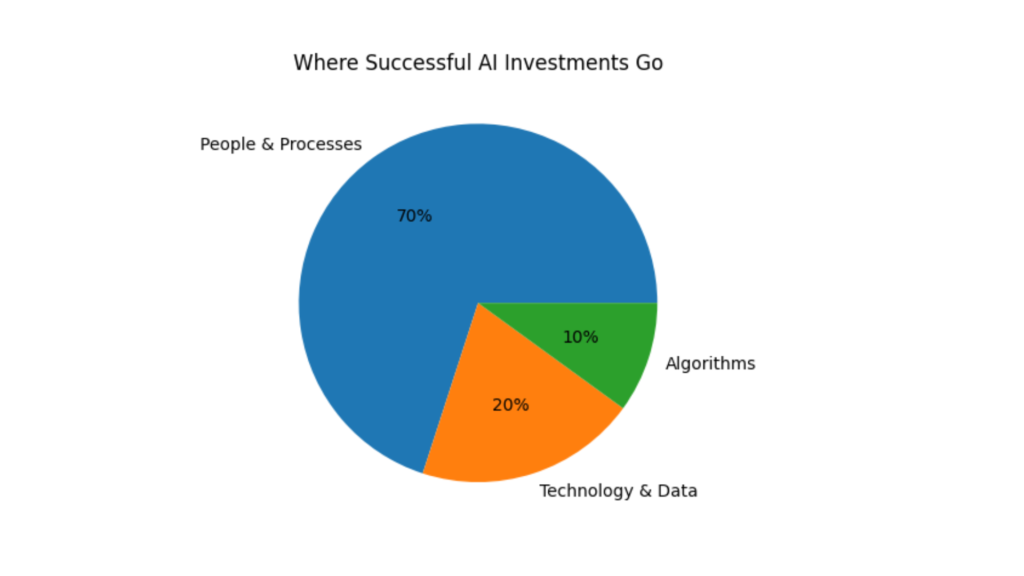
This distribution highlights an important truth. AI success is not primarily a technology challenge. It is an organizational transformation challenge.
Why the Mid-Market Opportunity Is So Significant
The Mid-Market Opportunity holds essential value because it represents an important business potential.
The mid-market sector faces major difficulties when trying to implement AI technology. These organizations possess sufficient operational capacity to create substantial data and operational challenges but they lack the resources needed to establish extensive internal AI research teams.
The Missing Middle concept reaches its highest visibility point in this particular situation.
Mid-market firms use AI tools for testing purposes but they face challenges when trying to build operational systems that can expand their usage.
The market presents a tremendous untapped potential for platforms which enable businesses to transform their AI testing into actual organizational benefits.
How Kandor AI Bridges the Missing Middle
The missing middle problem gets solved through the implementation of Kandor AI solutions. The development of Kandor AI specifically creates solutions for this problem.
Kandor AI provides organizations with AI capabilities that enable them to manage their financial operations and data systems and business processes through automated AI-driven workflows.
Financial advisory firms and accounting firms can use AI to improve their operations because it now serves as a core strategic ability that drives their daily work activities.
Organizations can achieve the following outcomes through Kandor AI which enables them to:
- Automate their financial analysis processes
- Create business insights through AI technologies
- Enable data sharing between their financial systems.
- Create more efficient reporting and decision-making methods.
- Provides better advisory services through real-time intelligent data.
The system enables firms to create interconnected systems which provide them with measurable business results instead of using separate AI solutions which function without interaction.
The Future of AI Belongs to Strategic Implementers
People compare artificial intelligence to the early development stages of the internet.
Initially businesses developed websites without any further technological advancements.
The internet brought about complete industry transformations through its impact on business operations.
AI development follows the same pattern as.
Current business operations involve multiple organizations testing different technological solutions.
The organizations which will shape the next ten years need to implement AI throughout their complete operational processes and all decision-making procedures and every aspect of their business functions.
Mid-market companies have access to substantial growth potential across their entire business operations.
Kandor AI serves as the essential component which organizations need to achieve successful AI implementation and bring about actual business change.